

Shannon Chamber Conference Calls on HR to Lead in Era of AI and Change
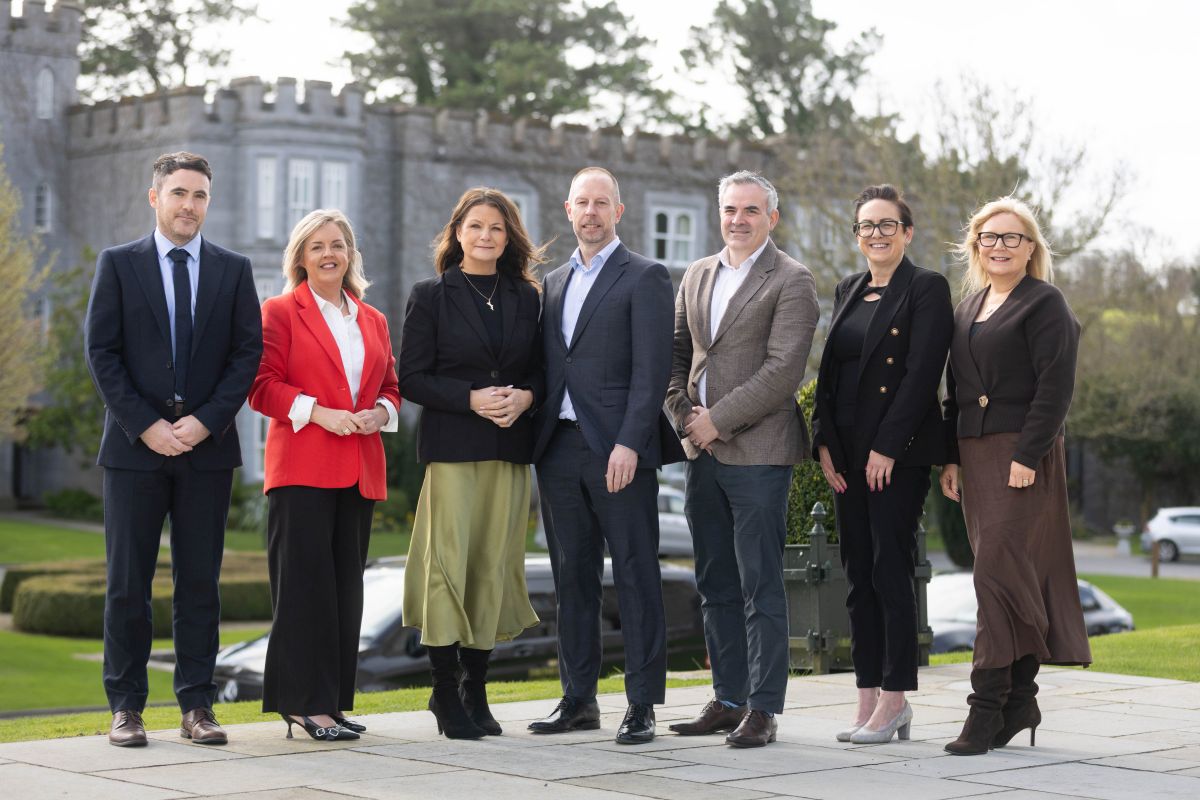
Shannon Chamber CEO Helen Downes (3rd left) pictured at the HR Conference held in Dromoland Castle Hotel with (from left): Daragh McGreal, director, KPMG Strategy; Jack Clarke, head of Reward, Irish Life; Derek McKay, director. Adare Trusted People Partners; keynote speaker Professor David Collings, chair of Sustainable Business at Trinity Business School, Trinity College Dublin; Vicky Howard, former country manager, Reagecon, a Calibre Scientific Company; and Deirdre Bennett, chair, Shannon Chamber HR Forum. Photograph by Eamon Ward
Traditional job structures are becoming obsolete as skills, not roles, become the key driver of value
The human resources (HR) function is at a critical turning point, facing what industry leaders describe as a “seismic shift” driven by artificial intelligence (AI), legislative reform, and global economic uncertainty.
This was the key message at HR 2026+: Adapt or Be Overtaken – Navigating the Seismic Shift in Legislation and AI, a conference hosted by Shannon Chamber through its HR Forum, in association with Adare Trusted People Partners, and co-sponsored by Shannon Chamber Skillnet.
Held at Dromoland Castle Hotel, the event brought together CEOs, HR leaders, and experts to share practical insights and strategies for organisations across the Mid-West and beyond. The clear message from the day was that HR must move from a support role to a central driver of business strategy and growth.
Opening the conference, Helen Downes, CEO, Shannon Chamber, said the pace of change facing organisations has accelerated significantly, placing new demands on HR professionals.
“The human resources landscape is no longer just evolving; it is undergoing a seismic shift. The goalposts for business as usual have moved, driven by the rapid pace of AI and the complexity of new legislation such as the EU Pay Transparency Directive,” she said.
Daragh McGreal, director, KPMG Strategy, outlined a mixed economic outlook. While Ireland continues to perform strongly, with record employment approaching three million, high export levels, and strong foreign direct investment, global uncertainty is increasing, he pointed to geopolitical instability, changing trade dynamics, and emerging security risks in Europe, alongside domestic challenges such as housing shortages and rising living costs.
“For HR, this means continued competition for talent, adoption of the right technology, and planning for ongoing uncertainty,” he said.
A CEO panel featuring Leo Clancy, CEO, Ei Electronics, and Vicky Howard, former country manager with Reagecon, a Calibre Scientific Company, explored how AI is already being used in Irish-based organisations.
At Ei Electronics in Shannon, AI tools are enabling software teams to work significantly faster, while also supporting operations and customer engagement. However, the panel stressed that AI is not just about technology; it is about people and how organisations adapt. They stressed that while AI will increasingly support day-to-day work, it still requires human oversight and that organisations will begin to see a mix of people and AI-driven agents, with critical thinking and judgement remaining essential, particularly in regulated sectors
The discussion highlighted HR’s central role in guiding how AI is introduced and used across organisations.
The EU Pay Transparency Directive was identified as one of the most immediate challenges facing employers. Jack Clarke, head of Reward at Irish Life, in a fireside chat with Derek McKay, director of Adare Trusted People Partners, described it as a scary but necessary change that will reshape how organisations approach pay.
New requirements will include salary ranges in job advertisements; employees having the right to request pay comparisons; enhanced gender pay gap reporting across clearly defined groups of similar roles; and the removal of pay secrecy clauses
“This will move organisations away from a black box approach to pay and towards greater fairness and openness. Done right, it can build trust and strengthen an organisation’s reputation as an employer,” she said.
James Ryan, CEO of WorkMatters, focused on the practical opportunities AI presents for HR teams. He said that automation can significantly reduce administrative workload, allowing HR to focus more on people, culture, and strategy.
“Start with the problem, not the technology. Look at where time is being lost and where processes can be improved before introducing AI,” he advised.
He shared examples of organisations reducing administrative tasks by up to 80%, freeing up time for more meaningful work.
Keynote speaker Professor David Collings, chair of Sustainable Business at Trinity Business School, Trinity College Dublin, said that organisations need to rethink how they define roles and talent.
He highlighted that while AI investment is increasing, many organisations are still not seeing full returns, largely due to a lack of alignment between technology and strategy.
His central message was clear: “Traditional job structures are becoming less relevant; skills are becoming the main way organisations measure value; and entry-level roles are changing as routine tasks are automated.
“HR’s role now is to identify the skills that will drive future success, rather than focusing solely on job titles. This is a real opportunity for HR to lead,” he said.
Closing the event, Deirdre Bennett, Chair of Shannon Chamber’s HR Forum, encouraged organisations to take practical steps such as investing in continuous learning; focusing on solving real business challenges; taking ownership of legislative change; and aligning people strategy with long-term business goals.
Summing up, Helen Downes said: “The message from the day was clear. Organisations that don’t adapt risk being left behind. Those that act now have a real opportunity to lead.”
She added that Shannon Chamber will continue to support businesses through co-funded training and upskilling programmes via Shannon Chamber Skillnet, along with ongoing engagement through its HR Forum.