

State funding schemes help businesses become greener, more efficient and more competitive… Shannon Chamber event hears
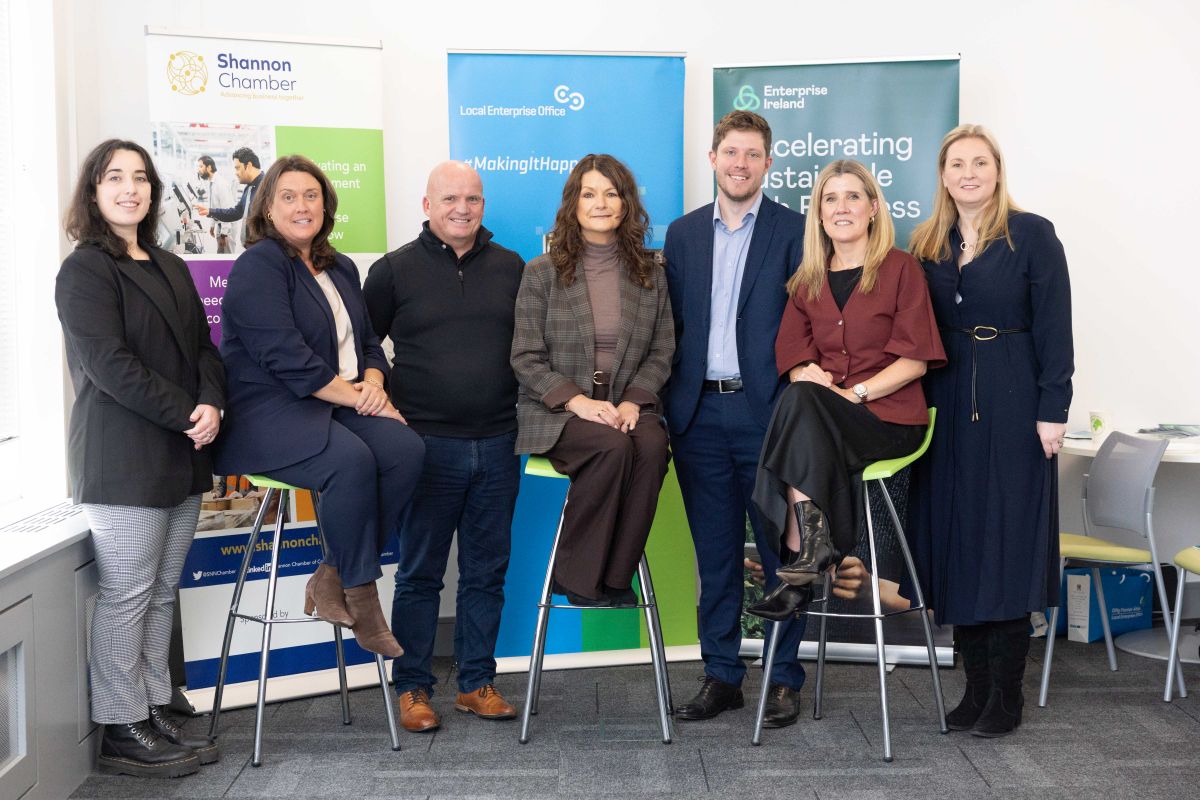
Helen Downes, CEO, Shannon Chamber (centre) pictured at the sustainability supports event with (from left): Ashleigh Hart, H&MV Engineering; Theresa Mulvihill Killeen. LEO Clare; Mark O’Sullivan, Iqutech; Dominic Schöne and Kathleen O’Regan, Enterprise Ireland; and Maeve Sheridan, Western Herd Brewing Company. Photo by Eamon Ward.
The scale of financial, technical and advisory supports available to help Irish businesses reduce their carbon emissions, improve energy efficiency and strengthen competitiveness was outlined at a recent Shannon Chamber event, where representatives of the Local Enterprise Office (LEO) Clare and Enterprise Ireland detailed the extensive range of assistance available to companies at every stage of their sustainability journey.
The event, held in Shannon Airport House, included two detailed presentations on State-funded supports followed by a panel discussion involving three companies – Iqutech, H&MV Engineering and Western Herd Brewing Company – whose experiences demonstrated how sustainability investments are delivering commercial, operational and environmental benefits.
A key message emerging from the event was that becoming a more sustainable business need not begin with major capital expenditure. Companies can initially access free expert advice, training and consultancy to assess their operations, identify potential savings and develop investment plans, before progressing to grant-aided projects.
Theresa Mulvihill Killeen, senior enterprise development officer with LEO Clare outlined the range of supports available to smaller businesses, including free mentoring and consultancy through the Green for Business, Lean for Business and Digital for Business programmes.
Green for Business provides up to two days of free specialist consultancy, enabling businesses to assess their environmental impact, identify opportunities to reduce energy and resource consumption and develop a roadmap for improvements.
Businesses requiring more extensive environmental expertise can avail of GreenStart, which offers up to €5,000 in support, covering 80% of eligible costs. Those progressing to investment can apply for the Energy Efficiency Grant, which covers up to 75% of eligible expenditure, to a maximum of €10,000, for qualifying energy-efficiency equipment and technologies. Eligible investments include energy monitoring equipment, smart controls, heat recovery systems, more efficient refrigeration and commercial equipment, and upgrades to older machinery. The supports are relevant to a broad range of enterprises, including retailers, restaurants, hospitality operators, manufacturers and service providers, subject to individual scheme eligibility.
Ms Mulvihill Killeen emphasised the importance of engaging with LEO before making investment decisions, as businesses must secure grant approval before purchasing equipment. She also highlighted the value of undertaking an initial review to ensure that investments are targeted at areas where the greatest savings and efficiencies can be achieved.
Enterprise Ireland’s senior sustainability specialist, Kathleen O’Regan, and industrial energy, climate tech and economic development senior executive, Dominic Schöne, outlined the agency’s extensive sustainability support programmes, ranging from introductory training and environmental consultancy to major capital investment in low-carbon manufacturing technologies.
Ms O’Regan stated that Enterprise Ireland has awarded €5.98 million in sustainability advisory and training grants across 738 projects between 2022 and the third quarter of 2026, supporting companies in developing sustainability strategies, carbon reduction plans, environmental management systems and internal expertise.
Among the supports available to companies are: GreenStart – grants of up to €5,000 to introduce environmental best practice and sustainability planning; GreenPlus: – funding of up to €50,000 to develop internal sustainability skills, environmental management capabilities and longer-term improvement programmes; Strategic Consultancy – grant support of up to €35,000, covering up to 50% of eligible costs, to assess the technical and commercial feasibility of major decarbonisation investments and; Training and development – free sustainability workshops, webinars and structured leadership programmes to help businesses understand environmental risks, develop plans and embed sustainability across their operations.
The agency also outlined its Energy and Environmental Aid supports, which assist manufacturing companies undertaking substantial investment to reduce fossil-fuel consumption and improve resource efficiency. Projects can include industrial heat pumps, electric boilers, heat recovery systems, energy-efficient production processes and integrated renewable energy solutions.
The scale of investment being supported is considerable. Since 2022, Enterprise Ireland has provided approximately €94 million in capital grant aid, contributing to wider industrial investments valued at approximately €1 billion.
Unlike standardised grant schemes, funding for major industrial decarbonisation projects is assessed individually, taking account of the company’s operations, technologies involved, emissions reductions and commercial benefits.
The agency also highlighted the Shared Island funding programme, which can support innovative energy and sustainability demonstration projects involving collaboration across the island of Ireland, with grant rates generally around 30% and potentially 40% for highly innovative projects.
Three companies – iQuTech, H&MV Engineering and Western Herd Brewing Company – shared their experiences of embedding sustainability into their operations.
Maeve Sheridan, co-founder in charge of marketing with Western Herd Brewing Company, which is based in Kilmaley, Co. Clare outlined how the company’s sustainability journey has progressed from operating with a diesel generator and no electricity grid connection to installing three-phase power, introducing heat recovery and planning further investment in solar energy. She highlighted the practical value of LEO consultancy, which helped identify opportunities to save energy, reduce costs and improve efficiency. A decision to move from glass bottles to cans also delivered benefits in packaging, transportation and operational costs.
Mark O’Sullivan, co-founder of Iqutech, spoke about the commercial opportunities emerging from the circular economy, explaining how repair, refurbishment and remanufacturing have developed into a substantial business activity.
Through a major telecommunications customer programme, the company repairs and refurbishes approximately 80,000 parts each month, extending product life, recovering valuable materials and reducing the requirement for new equipment.
Mr O’Sullivan emphasised that sustainability and commercial success are closely linked, with circular economy activities delivering measurable financial value while also helping customers achieve environmental objectives.
Ashleigh Hart, sustainability lead at H&MV Engineering provided a perspective on how sustainability is being embedded within the governance and operations of a rapidly growing international business. With approximately 2,000 employees, the company has established board-level oversight of sustainability, supported by an ESG committee and clear responsibilities across senior management. It has also used Enterprise Ireland’s GreenPlus support to develop its climate transition planning and internal sustainability capabilities.
Ms Hart highlighted the growing importance of internationally recognised environmental standards, carbon reduction planning and sustainability reporting in securing new business, particularly as customers increasingly include environmental and social requirements within procurement and tendering processes.
Commenting on the event, Shannon Chamber CEO Helen Downes said the presentations and panel discussion demonstrated why companies should view sustainability as a business investment rather than simply an additional cost or compliance requirement.
“The scale and range of financial supports outlined by LEO Clare and Enterprise Ireland were considerable. What was particularly encouraging was that there are supports available for businesses at very different stages of development, from those taking their first steps towards greater energy efficiency to companies planning major capital investment in decarbonisation.
“Many businesses may not fully appreciate the extent of the assistance available or the fact that they can begin by accessing free specialist expertise to identify opportunities within their operations.
“The experiences shared by our panel companies were equally important. They demonstrated that sustainability is not simply about reducing emissions. It is about reducing costs, using resources more efficiently, developing new business opportunities and remaining competitive in markets where environmental performance is increasingly influencing purchasing decisions.”
Ms Downes said that sustainability credentials were becoming particularly important for SMEs supplying larger companies.
“We are increasingly hearing that suppliers are being asked to demonstrate their carbon footprint, environmental policies and progress towards sustainability targets. For smaller businesses, understanding and responding to these requirements can be challenging, but it can also represent a significant opportunity.
“The message from this event was clear: there is expertise and funding available to help companies make that transition. Businesses should take the time to investigate the supports relevant to their operations and identify how they can be used to achieve meaningful commercial and environmental improvements.”
Ms Downes added that Shannon Chamber would continue to work with enterprise development agencies and businesses across the Mid-West to encourage greater awareness and uptake of sustainability supports.