
Energy decarbonisation now a competitiveness and resilience issue for business, Shannon Chamber event hears
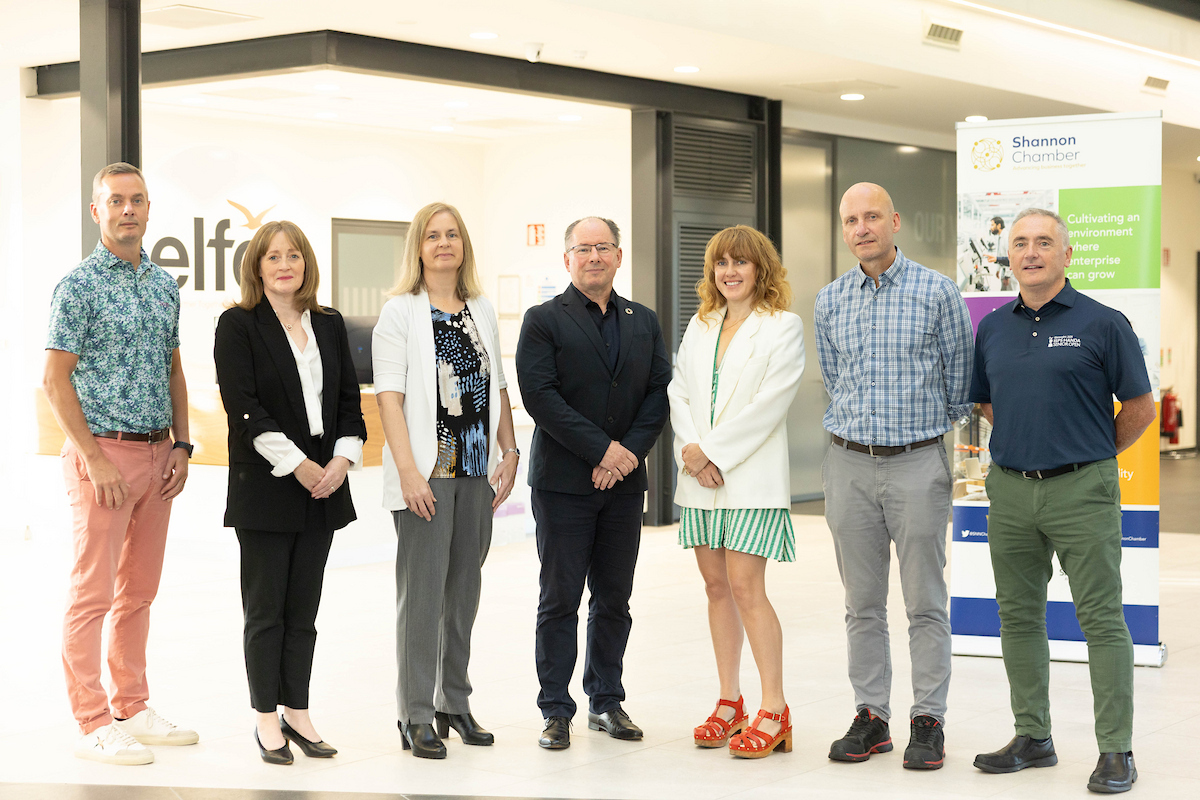
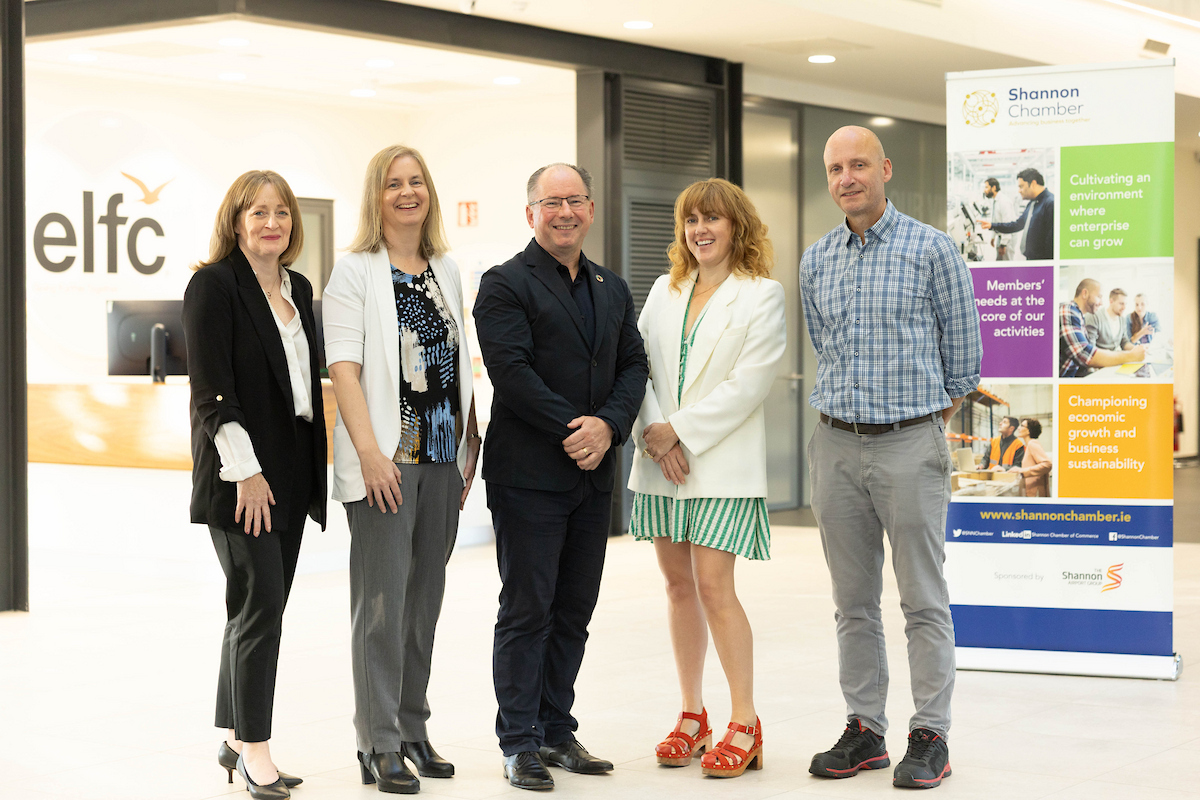
Barry Gavin, chair, Mid-West Sustainability Network (centre) pictured at the event in Engine Lease Finance Corporation in Shannon with (from left) Michelle McManus, the Falls Hotel & Spa in Ennistymon; Fiona Lavin and Kathleen Moore, SEAI; and Tom Prendergast, Stryker. Photograph by Eamon Ward
Companies urged to avail of funding and expert supports to cut energy costs, strengthen resilience and reduce emissions
Energy decarbonisation is no longer simply an environmental consideration but an increasingly important business competitiveness and resilience issue. This was a key message delivered to attendees at a Mid-West Sustainability Network event hosted recently by Shannon Chamber.
The event, ‘Building a More Competitive and Resilient Business Through Energy Decarbonisation’, brought together representatives from the Sustainable Energy Authority of Ireland (SEAI), Stryker Limerick and the Falls Hotel & Spa, Ennistymon, to demonstrate how companies of very different sizes can reduce energy consumption and emissions while also delivering measurable financial and operational benefits.
Hosted at Engine Lease Finance Corporation (ELFC) in Shannon Free Zone, the event highlighted the extensive range of advisory, grant and financial supports now available to both large energy users and SMEs.
Opening the event, Barry Gavin, chair of the Mid-West Sustainability Network, said the business case for sustainability had changed significantly since the network was established in 2022.
“Sustainability has moved from being a ‘nice to have’ to becoming a fundamental business consideration. The discussion is increasingly about adaptation, resilience and competitiveness.
“Businesses are facing higher energy costs while banks, insurers, customers and Government are also looking more closely at companies’ transition plans. There is a cost associated with acting, but there is also a very real and continuing cost associated with doing nothing.
“The important message for companies is that they do not have to undertake this journey alone. There is expertise, funding, and practical support available, and many of the measures companies can take deliver a clear and measurable payback,” he said.
Addressing the national decarbonisation challenge, Fiona Lavin, programme manager of SEAI’s large industry energy network (LIEN) outlined the scale of the emissions reductions required from industry – 35% reduction by 2030 from a baseline of 2018 – and the supports available to larger energy users.
She encouraged companies to follow SEAI’s “3 Rs” approach to decarbonisation: first reduce energy demand, then reuse energy through measures such as heat recovery and heat pumps and finally, refuel through renewable energy or alternative fuels.
She said tackling energy demand and waste first can significantly reduce the scale and cost of capital investment required later.
Among the supports outlined were SEAI’s Large Industry Energy Network, which provides participating companies with expert consultancy and access to specialist events and working groups, as well as grant programmes including the Support Scheme for Renewable Heat, Excellence in Energy Efficiency Design (EXEED), and Community Energy Grant.
The practical impact of combining a structured decarbonisation plan with grant funding was demonstrated by Tom Prendergast, senior project and utilities engineer with Stryker Limerick.
Stryker’s 129,000 sq ft Limerick facility has developed a three-year green capital roadmap covering 14 initiatives and approximately €13 million in investment. The programme includes enhanced energy monitoring, heat recovery, HVAC optimisation, electric furnaces, heat pumps, solar generation, battery storage and the exploration of district heating.
Approximately €3 million in IDA grant support has been approved towards the programme, which is expected to reduce annual CO₂ emissions by around 1,500 tonnes.
Mr Prendergast said one of the key lessons from Stryker’s experience was the importance of establishing a clear energy baseline, digitising energy monitoring early and recovering waste heat before investing in additional plant or technology.
He also highlighted grid capacity as a significant challenge for industrial decarbonisation, noting that delays in securing additional electricity import capacity can directly affect the timing of projects such as heat pumps and electrification.
For smaller businesses, Kathleen Moore of SEAI’s SME Business Decarbonisation Supports, outlined a pathway built around three steps: understand, assess, and invest.
“Know how you use energy and create an action plan, assess your energy audit to identify actions and, invest in energy efficiency measures and renewables,” she advised.
Free energy management training and SEAI’s online Energy Academy can help companies identify opportunities to reduce energy use, while businesses with annual energy expenditure of more than €10,000 can access a €2,000 energy audit voucher.
SEAI’s Business Energy Upgrade Scheme can provide funding of up to 50 per cent towards eligible measures including heat pumps, insulation, controls, heat recovery and building management system optimisation. Non-domestic solar grants are also available for qualifying projects.
Ms Moore encouraged companies to seek grant approval before commencing works and to ensure finance teams are aware of supports including the Accelerated Capital Allowance and the Energy Efficiency Obligation Scheme.
Demonstrating that major progress is equally possible for an independent business, Michelle McManus, sales and marketing manager at the Falls Hotel & Spa in Ennistymon, outlined the hotel’s sustainability journey.
The 140-bedroom hotel began formally measuring its environmental performance in 2011 and established a carbon baseline in 2016.
A major milestone was the installation of a 220kW hydroelectric turbine, commissioned in 2018. By the following year, the hotel had reduced its emissions by 70 per cent and its energy costs by 60 per cent. Emissions subsequently fell by approximately 80 per cent and the hotel achieved carbon-neutral certification in 2021.
Ms McManus said the hotel’s experience also demonstrated the importance of smaller measures, from reducing water and energy use to eliminating single-use plastics, enhancing biodiversity and encouraging guests to participate in sustainability initiatives.
She said strong staff and owner buy-in, coupled with taking the process one step at a time, had been critical to the hotel’s success.
The event also heard that solar generation, battery storage, power purchase agreements and energy-as-a-service models can provide alternative routes for businesses seeking to decarbonise while managing upfront capital requirements.
Concluding the event, Barry Gavin said the strongest message was that businesses should view energy decarbonisation as an investment rather than simply a cost.
“Upfront capital and effort can generate a measurable return. Inaction, on the other hand, creates a cost that is never recovered.
“Even if the environmental benefits are set aside, there is now a very strong business case for reducing energy demand, improving resilience and taking advantage of the supports available.
“The examples from Stryker and the Falls Hotel show that there is no single route to decarbonisation. What matters is starting, understanding where energy is being used, taking the achievable steps first and building from there.”
The Mid-West Sustainability Network will continue the discussion at its annual conference, which takes place on 21 October 2026 as a half-day event focused on helping businesses strengthen competitiveness and resilience through practical sustainability action. The conference, which will feature speakers from Edwards Lifesciences, Irish Rail, and Enfonic, will be on interest to companies at all states on their sustainability journeys or those seeking to become a supplier to a larger organisation with a sustainability component part of the tendering criteria. The keynote address will be delivered by Dr. Matt Kennedy, Global Head of Client Transformation, IDA Ireland.
For further details or to book a place, log onto www.shannonchamber.ie/events/mid-west-sustainability-network-conference-2026-save-the-date/